Why Pool Water Turns Green When Chlorine Is High
October 27th, 2026 | by jackiec
Last updated: October 2026
Green pool water can persist despite high chlorine because a test may measure total chlorine, stabilizer slows sanitation, or metals cause the color. More alkaline water and poor circulation can also leave algae growing despite an apparently strong test result.
We recommend diagnosing before adding more shock, especially if the water changed color immediately after treatment. Start with appearance, then test the water chemistry before choosing a fix.
Key Takeaways
- Test free chlorine, not just total chlorine.
- Cloudy, slippery water suggests algae; transparent green water can indicate metals.
- Correct chemistry and filtration before adding clearing products.
What Does the Water’s Appearance Tell You?
Appearance gives you a starting point, but it doesn’t replace testing.
| What you notice | Possible cause | Next step |
|---|---|---|
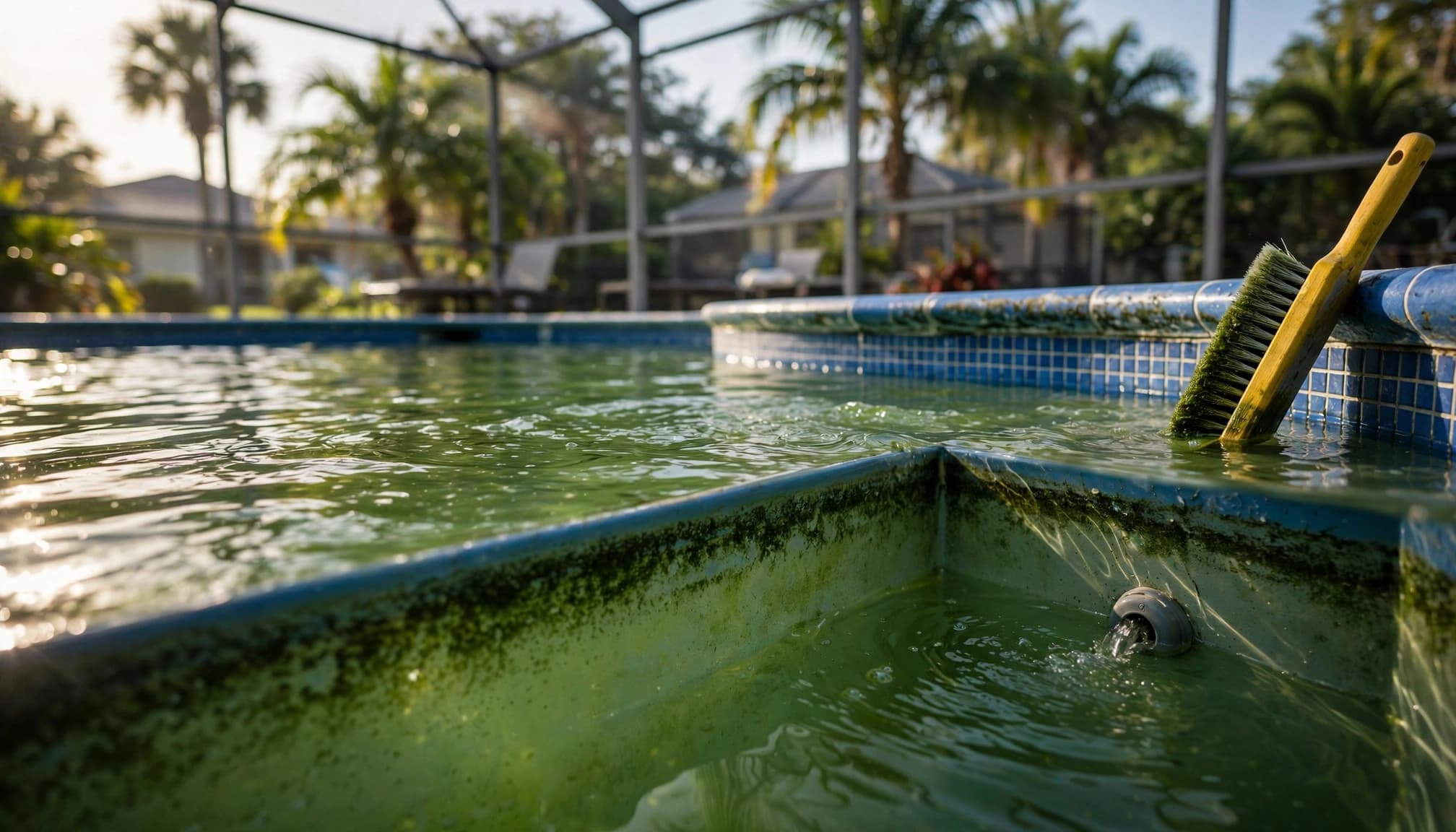
| Green cloudiness and slippery walls | Algae | Test free chlorine, pH, and stabilizer |
| Transparent green tint after shocking | Oxidized copper or iron | Test pool and fill water for metals |
| Persistent haze with weak returns | Poor filtration or circulation | Inspect equipment and filter pressure |
| White milkiness after calcium-containing shock | Calcium precipitation | Test pH, alkalinity, and calcium hardness |
Avoid repeating shock until you’ve separated algae from metals or mineral cloudiness.
Tampa Bay downpours also introduce debris and runoff. Our guide to cloudy water after rain covers that cleanup.
Why Does Green Pool Water Resist Chlorine?
Free Chlorine and pH Matter
Free chlorine is available sanitizer; total chlorine also includes combined chlorine. A high total reading doesn’t establish adequate sanitation.
A free chlorine level of about 2 to 3 parts per million is a common maintenance target, but stabilizer levels can require more. An algae treatment needs a separate, measured treatment target.
Before shocking, aim for pH 7.4 to 7.6 and total alkalinity 80 to 120 parts per million. Chlorine becomes less effective above 7.6. The often-cited estimate of 25% effectiveness at pH 8 describes unstabilized chlorine chemistry, not every stabilized pool.
Stabilizer, Nutrients, and Circulation Affect Results
Cyanuric acid (CYA) protects chlorine against sunlight, but excessive CYA slows its action. Around 75 to 80 parts per million, investigate whether stabilizer is driving chlorine requirements too high. This isn’t an absolute “chlorine lock.”
For conventional outdoor pools, 30 to 50 parts per million CYA is a common starting range; some systems specify otherwise. Replacing 30% to 50% of the water may help. Reducing 80 parts per million to 50 parts per million requires approximately 37.5% replacement with CYA-free water.
Because Florida groundwater can create structural risks, have a qualified professional plan water replacement.
Phosphates feed algae. Some guides recommend below 500 ppb, but phosphate removal doesn’t replace sanitation. Meanwhile, dirty filters and weak circulation leave trouble spots untreated.
How Can You Clear Green Pool Water?
For established pools, we recommend this sequence. Newly finished pools need their builder’s startup instructions instead.
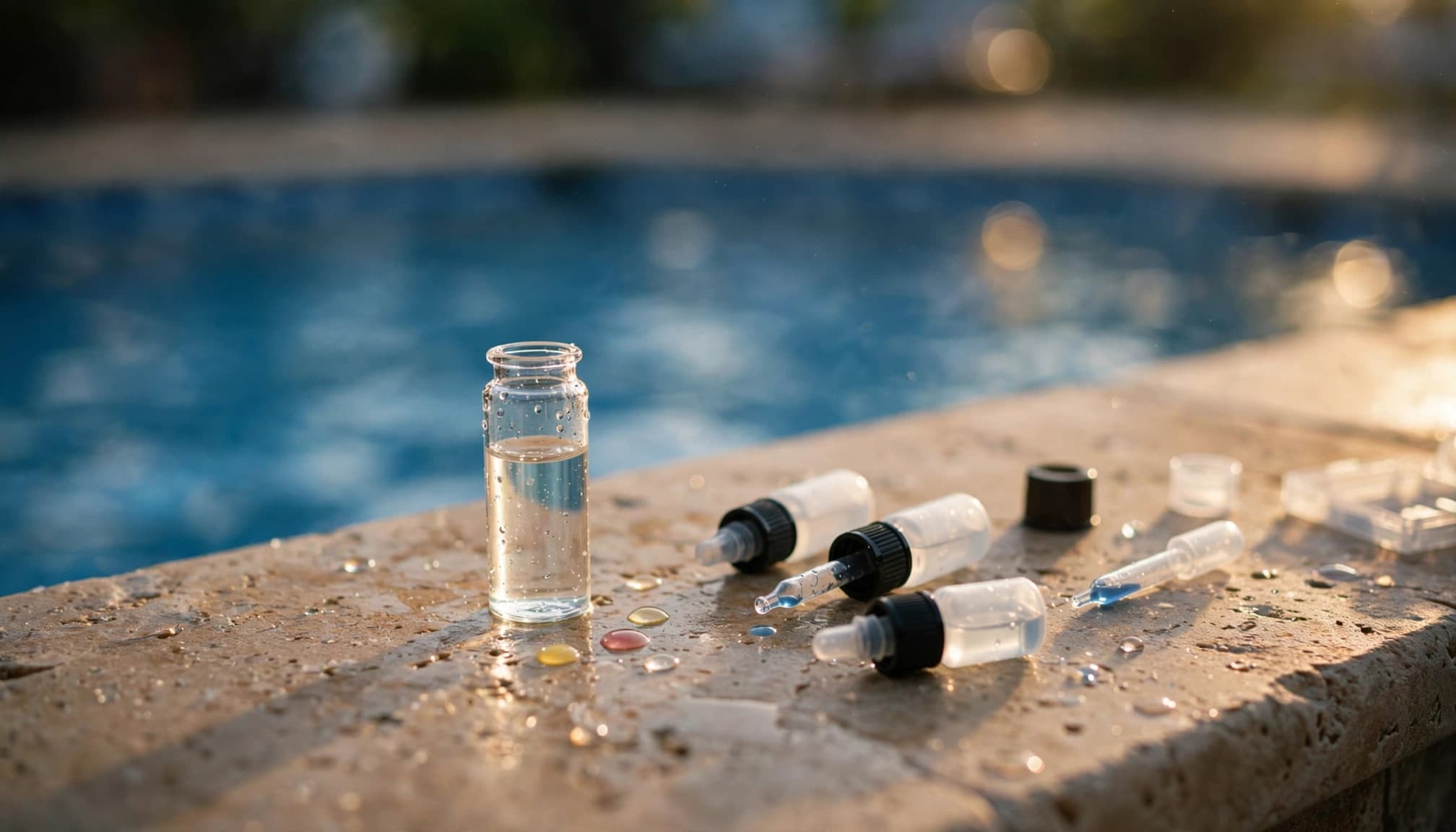
- Test before treating. Measure free and total chlorine, pH, alkalinity, and CYA. Add metals testing for transparent green water, particularly after shocking. A copper-based algaecide can also cause discoloration.
- Remove debris and restore flow. Empty baskets, brush with a finish-compatible brush, and inspect returns. Clean or backwash the filter as its instructions require.
- Correct the diagnosed problem. Balance pH and alkalinity before algae treatment. For confirmed metals, use an appropriate metal-control treatment instead of repeated shock. If tests confirm high CYA in an overstabilised pool, address it before escalating chlorine doses.
- Dose algae treatment accurately. Swim University’s shock guidance describes a standard granular dose of 1 pound per 10,000 gallons, doubled for light green and tripled for darker green algae. Thus, a 20,000-gallon light-green pool needs 4 pounds under that guideline. Check the active ingredient and label directions for calcium hypochlorite. Measured chemistry and the product label, not a generic dose, determine how much chlorine shock to use. Add shock at dusk to reduce sunlight loss. Never mix chemicals.
- Filter and reassess. Run filtration for at least eight hours after shocking, ideally continuously for 24 hours while clearing, if equipment instructions allow. Follow the equipment’s guidance for pump run time. Blue-grey cloudiness often indicates dead algae, although persistent milkiness can have other causes. Retest the key readings after 24 hours.
- Remove remaining particles. Clarifier helps the filter capture fine material. Flocculant settles particles for slow vacuuming to waste, so it requires compatible equipment. Vacuum settled algae to waste using the waste setting only if your equipment supports it, rather than sending it through the filter.
If visibility isn’t improving after 48 hours, reassess chemistry, filter condition, and circulation before adding products.
Frequently Asked Questions
Does Vinegar Remove Algae, or Are Other Treatments Better?
Vinegar isn’t a dependable pool algae treatment and can disrupt water balance. Certain labeled algaecides kill algae, but they supplement sanitation rather than replace it. Avoid copper-based products when metals are implicated. Clarifier, flocculant, and phosphate remover don’t substitute for killing active algae.
When Is Swimming Safe Again?
Keep everyone out while water is green, cloudy, or too murky to clearly see the bottom and drain.
Before reopening, confirm clear visibility, balanced pH, adequate free chlorine, and compliance with the shock label’s re-entry directions. The often-quoted 1 to 3 ppm range isn’t universal. CDC home-pool testing guidance recommends at least 2 ppm free chlorine when CYA is present, not a universal 3 ppm maximum.
Clear Water Starts With the Right Diagnosis
A high chlorine result can’t identify the cause of green water by itself. We recommend matching treatment to test results, then giving filtration time to remove the debris.
Planning a new backyard pool? Explore our Tampa pool design and construction services. Book a free consultation or call 813-474-2024 to discuss your outdoor living plans with Tropical Escapes FL.